Beyond the Stamp: Making 925 Silver Verifiable in Bulk
Why a Stamp Alone Isn't Enough at Scale
A "925" stamp on a single ring is easy to verify. Across thousands of pieces and many production batches, the stamp alone proves nothing — customs, marketplaces, and your own customers want documented, verifiable evidence on file. At volume, 925 silver verification means documentation, not just a mark.
What a Complete 925 Documentation Package Contains
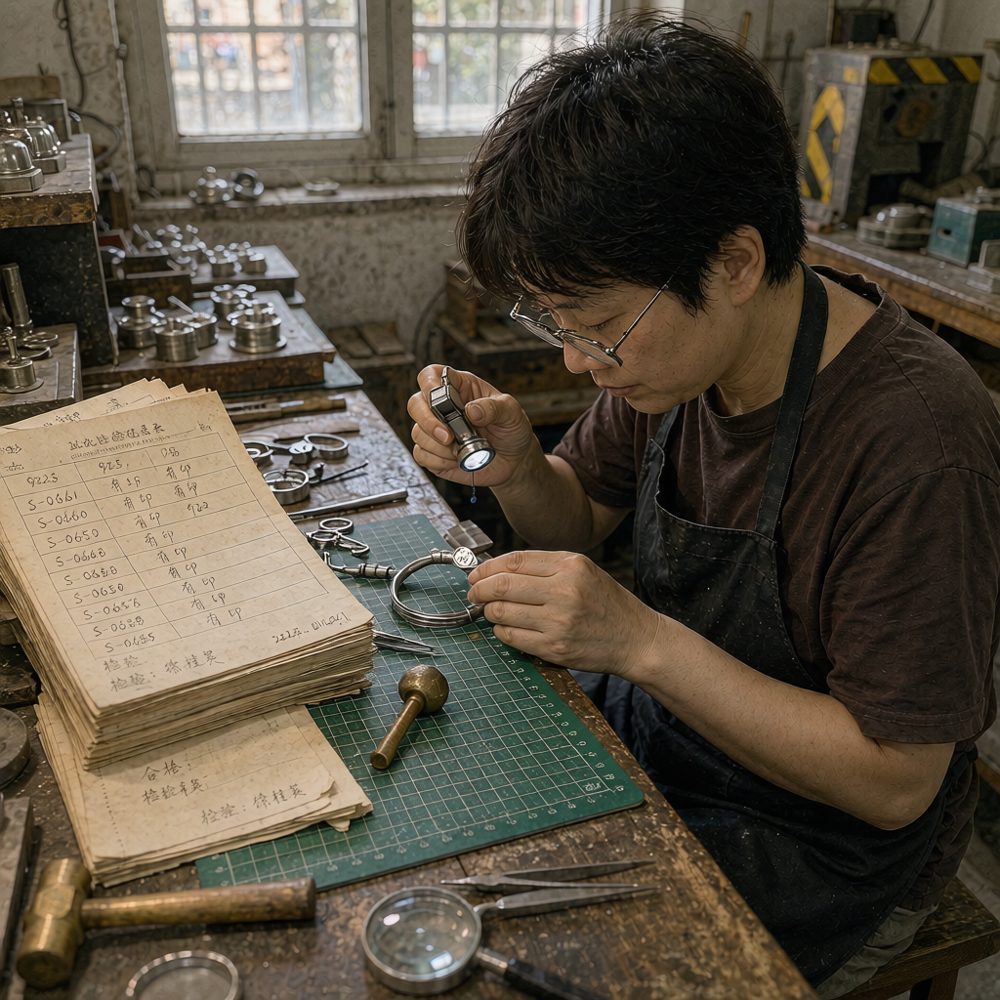
For B2B sourcing, the proof is a file, not a feeling. A complete package can include an SGS report stating silver percentage and alloy composition, silver certification such as REACH and RoHS coverage for the 925 material, and a plating-thickness record — these are arranged on request, not enclosed with every shipment.
Verification Built Into the Production Line
At our Haifeng workshop, 925 silver verification is part of the 14-step process: the alloy is checked at intake, the fineness stamp is applied under quality control, and a second-stage check at our Guangzhou warehouse confirms the documentation matches the piece before worldwide shipping. Verification is a step in the line, not a final guess.
Traceability: Batch Records We Keep on File
Every batch keeps its production and QC records on file. Test and certification reports such as SGS, REACH, or RoHS are provided to the buyer on request — they are not enclosed with every shipment. That record trail supports customs clearance and marketplace listing compliance in the EU and US, and lets a buyer trace a single questionable piece back to its production lot. Traceability is what makes "real 925" defensible after delivery.
What to Put in Your Purchase Order
To make 925 silver verification contractual, write it into the PO: request SGS or third-party verification for the specific batches that need it, keep silver certification current where applicable, and confirm plating thickness for plated designs. For custom 925 silver orders, quality control should verify the stamp matches the batch record before dispatch. Learn more on our about page, or talk to us about certified shipments.
Reading a Test Report: What to Look For
A useful 925 silver report states the tested silver percentage, the alloy elements detected, and the method used. For plated pieces, it should also show plating thickness. Do not accept a summary statement alone; the data table is what customs and marketplaces review. Ask which batch or production lot the report covers so the document matches the goods you receive. If a report covers a different lot, it does not verify your shipment.
When Third-Party Verification Is Worth the Extra Step
For buyers entering regulated marketplaces or regions with strict jewelry compliance, third-party testing is often the difference between a smooth launch and a listing rejection. We can provide SGS, REACH, and RoHS documentation for our 925 silver lines on request — typically arranged for specific orders or compliance-sensitive shipments, not as a standard report for every batch. If your market requires additional testing, we can coordinate a recognized third-party sample test before full production begins. This step is optional for many orders, but it is a worthwhile safeguard for large or compliance-sensitive launches.