Answer: Vet a silver OEM/ODM partner with six checks before you pay any deposit: confirm the physical workshop exists, match test reports to the exact alloy you are buying, judge finish and stone setting on a real sample, get MOQ and tooling terms in writing, sign an NDA before releasing CAD files, and treat any quote far below the live silver price as a warning. A partner that passes all six will quote within 24 hours and show the floor on video without hesitation.
1
Workshop, not just a catalogueSee the actual production floor, lines and equipment.
2
Reports that match the alloyTest documents must cover 925 sterling, not just brass.
3
A sample you can measureCheck plating evenness, prong work and dimensions.
4
Written commercial termsMOQ tiers, tooling fee, refund trigger, lead times.
5
Design protectionNDA signed before any technical drawing leaves your side.
6
Price sanityA quote below the metal cost is a red flag, not a bargain.
How to run the six checks
Why should I start with the workshop instead of the catalogue?
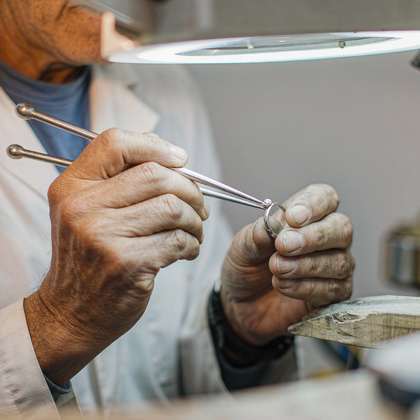
Anyone can publish a catalogue. What separates a manufacturer from a middleman is whether design, mould making, casting, polishing and stone setting happen under one roof. Ask for a live video walkthrough and let them pan across the floor without cutting away. Our workshop in Haifeng, Guangdong, 70+ specialists, 5 lines and 20+ machines on a 14-step in-house process, so a technical question gets answered by pointing a camera at the station.
If a supplier can only show an office or stock photos of machinery, price the quote as a trading margin, not a factory cost.
Which documents actually prove material and compliance?
Ask for the business licence, then for test reports by name, and check three things: the alloy listed (925 sterling, not brass), the finish tested (polished, or plated and at what thickness), and the issuing laboratory. A REACH report on gold-plated brass tells you nothing about a silver ring. SGS, REACH, RoHS and ASTM standards, and those documents are issued per product family.
How do I judge finish and stone setting without a lab?
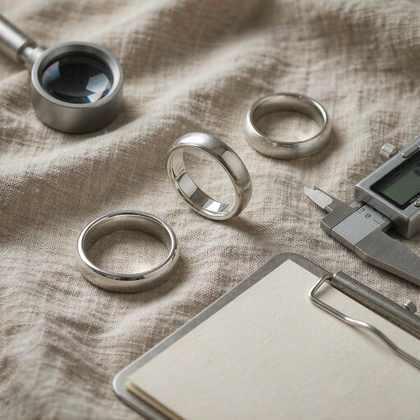
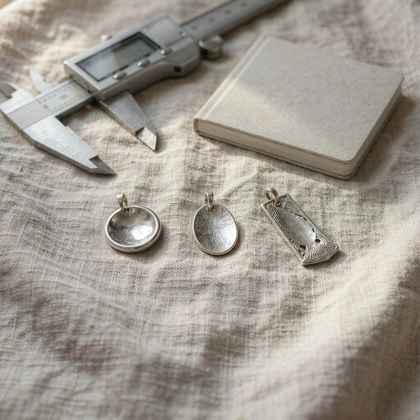
Order a sample and use your own eyes and hands. Rub the surface with a white cloth: patchy colour or a grey smear means thin or uneven plating. Prongs should sit flat and every stone should sit level; tug each one gently, because a well-set stone does not rock. Measure a few pieces with a caliper, since width and thickness drifting across a batch is the first sign of a loose process.
We plate at 0.1–0.3 micron as standard and adjust it when a market needs a heavier layer, so thickness is a specification you can request.
What commercial terms should be in writing before the first order?
1MOQ tier confirmed
2Tooling fee and refund rule
3Sampling window
4Bulk lead time
5Deposit and payment channel
6Quote validity
On silver the metal portion moves with the market, so agreeing a number without a validity window is how disputes start. Our MOQ is 25 pieces for futures orders, 100 for fully personalised work and 100+ for 18K gold-plated customisation; a USD 30+ plate fee applies to custom tooling, scaled by difficulty and gram weight, and is refunded once cumulative volume across your account reaches 100 pieces. Sampling runs 7–15 days, bulk 25–40 days after deposit, and quotes hold for 24 hours because silver is priced from the day's spot rate.
How do I protect my designs before sharing files?
Sign an NDA first, then release the technical pack in stages. Start with a reference image and a size range, move to a dimensioned drawing once the NDA is countersigned, and leave the full CAD until the sample is approved. Ask in writing whether the mould is used for any other buyer. If a supplier offers to reproduce another brand's piece item for item, treat it as legal risk you are inheriting, not a service.
Which red flags should end the conversation?
Walk away when
- The price sits below the metal's spot cost.
- No live tour is ever possible, only photos.
- Nobody can state which alloy is used.
- Full payment is demanded before production.
- Design copying is offered as a feature.
Stay when
- They correct your brief on technical grounds.
- Sampling and QC steps are documented.
- Reports are named, scoped and dated.
- Defects are reworked at their cost.
- One person owns your file end to end.
What does a healthy first order look like?
A workable rhythm is: sample, measure, approve in writing, pay 30% deposit, produce in 25–40 days, inspect, then ship. Ask what happens if a piece fails inspection, before the carton is sealed. Non-human-caused quality issues reported within 7 days are compensated at 100%, and per-batch records let an issue be traced to a workstation; anything outside that window is discussed case by case.
Get your partner checklist reviewed